AURUM
Training
The complete 6-minute workout protocol, all six exercises, and how to read performance data.

Why One Set Suffices — and Why 5 Reps × 12 Seconds
Why One Set Is Sufficient
- Hormesis: exercise is a stressor — at the right dose, it triggers adaptation; too much causes damage
- Inroad: each rep depletes momentary strength capacity. At failure, all motor units recruited — signal complete.
- Ralston et al. 2017 (Sports Medicine meta-analysis): single-set-to-failure = multi-set when effort is equated
- Multi-set training only advantages highly trained athletes who have exhausted low-volume response
- Additional sets after failure extend recovery debt without extending adaptive signal
- AURUM isokinetic: maximum intensity from rep 1 — no "warm-up" sets needed
Why 5 Reps × 12 Seconds
- Optimal TUT range for hypertrophy: 40–90 seconds of continuous tension
- 5 reps × 12 seconds = 60 seconds TUT — center of the optimal window
- 4s concentric: slow enough for isokinetic machine to accurately measure and adapt
- 8s eccentric: muscle generates 20–40% more force eccentrically — most productive phase
- Eccentric emphasis: Roig et al. 2009 — eccentric training produces superior strength and hypertrophy
- No pausing at top/bottom — continuous tension throughout all 5 reps
The Recovery Cascade
Inflammation Resolution (0–24h)
Controlled inflammation clears cellular debris. Do NOT suppress with NSAIDs or cold water immediately post-session — this blunts the adaptive signal.
Muscle Protein Synthesis (24–72h)
Satellite cells activate. Damaged fibres repaired and rebuilt slightly larger. MPS peaks at 24–36h post-session. Protein intake in this window is critical.
Glycogen Resynthesis (0–24h)
Muscle glycogen replenished. Carbohydrate within 2h post-session accelerates this process. Essential for next-session readiness.
CNS Recovery (24–96h)
High-intensity training creates central nervous system fatigue beyond local muscle fatigue. Heavy sessions require 48–96h neural recovery. Overlooked but critical.
Supercompensation Window (Day 5–7)
Body rebuilds above the previous baseline. This is the target window for the next AURUM session. Train here, not before — earlier interrupts adaptation.
Exercise 1: Leg Press — Exercise 2: Row
Leg Press
Setup: Feet shoulder-width, full foot contact, knees track over pinky toes
ROM: Stop 5–10° short of full extension — maintain continuous tension
Error 1: Knee cave (valgus) → cue "knees over pinky toes"
Error 2: Heel lift → cue "feel the heel heavy on the plate"
Error 3: Lumbar flexion at bottom → reduce ROM until hip mobility improves
Row
Key initiation: SCAPULAR RETRACTION first — not elbow flexion
Cue: "Pull shoulder blades together first, then let elbows follow"
Therapeutic: Strengthens the undertrained retractors — corrects desk posture
Error 1: Arm initiation → cue "lead with elbows, hands just follow"
Error 2: Trunk lean-back (momentum) → cue "chest proud, wall behind you"
Exercise 3: Chest Press — Exercise 4: Torso Extension
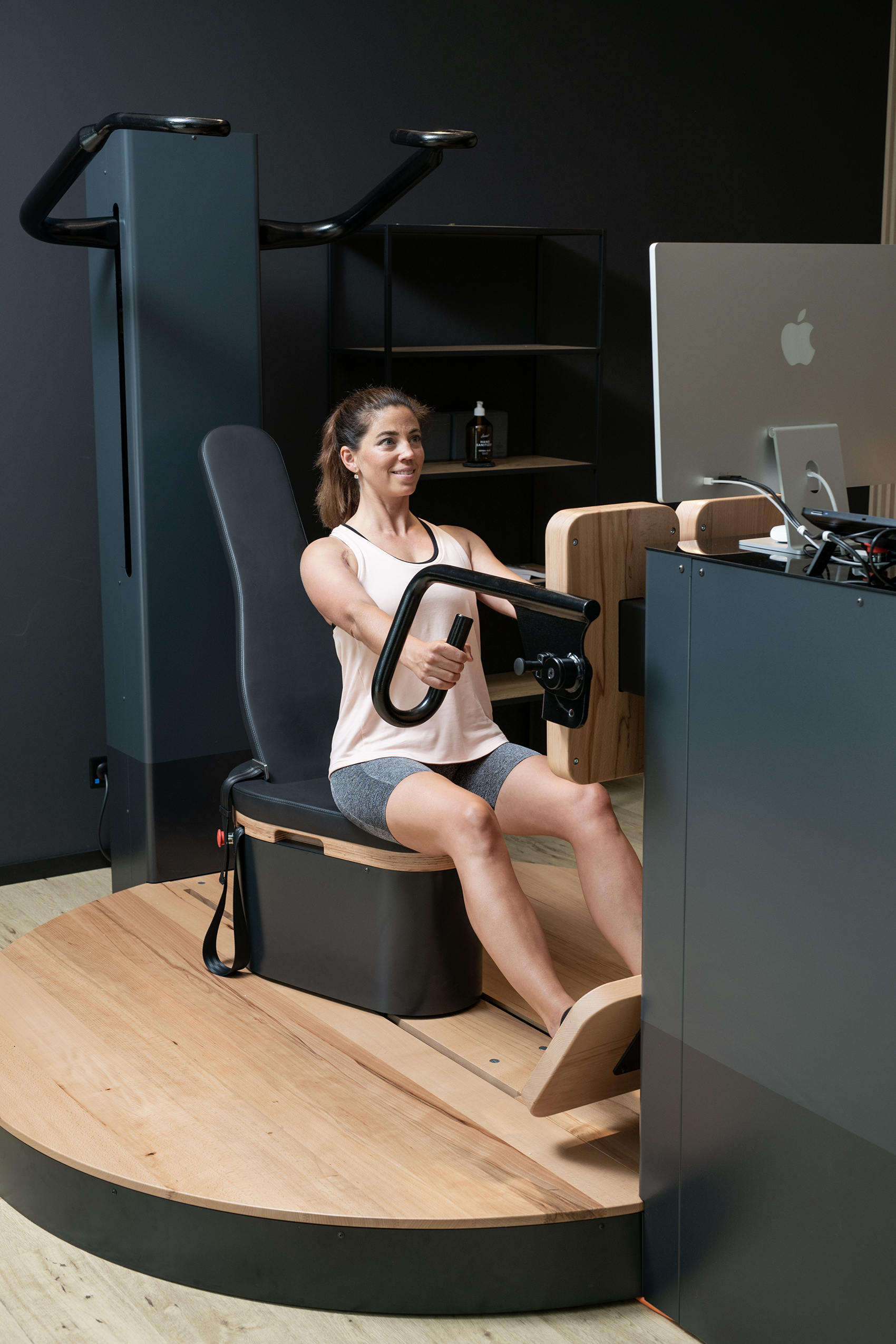
Chest Press
Mind-muscle: Calatayud et al. 2016 — focused attention increases pec activation 22%
Cue before every rep: "Squeeze your chest as you push — arms are just levers"
Elbow angle: 45° — not flared overhead (shoulder impingement risk)
Error 1: Wrist extension (breaking backward) → maintain neutral wrist
Error 2: Neck strain/chin poke → head back against pad, press tall
Torso Extension
Key insight: Multifidus atrophies in chronic LBP — this exercise is therapeutic, not contraindicated
ROM: Stop at neutral spine — do NOT hyperextend at the top (facet joint loading)
Eccentric: Highest-risk phase — coach continuous resistance on return
Error: Gluteal substitution (hip thrust) → cue "feel lower back, not glutes"
Caution: Acute/severe LBP requires medical clearance before loading
Exercise 5: Pull Down — Exercise 6: Overhead Press
Pull Down
Context: Largest back muscle — most undertrained in sedentary adults
Key initiation: Shoulder DEPRESSION first, not elbow flexion
Cue: "Put shoulder blades in your back pockets — elbows come DOWN toward hips"
Error 1: Arms-only pull (shoulders shrug up) → cue "shrug DOWN before you pull"
Error 2: Excessive trunk lean-back → stay upright throughout
Overhead Press
Complexity: Most technically demanding — requires thoracic extension and shoulder external rotation
Day 1 clients: Many desk-posture clients lack full ROM — start with partial range
Error: Lumbar hyperextension (compensation for limited shoulder mobility)
Cue: "Brace your core like someone is about to tap your stomach"
Caution: Shoulder pathology requires medical clearance — adjust ROM or substitute
Reading Client Data — Power Curves
Smooth Bell Curve
Builds to mid-range peak, returns symmetrically. Eccentric curve near-equal to concentric — client is actively resisting return. Reinforce and celebrate.
Ballistic Initiation
Sharp force peak at movement start. Indicates poor neuromuscular control. Cue: "Ease into the push — no explosive start."
Premature Mental Release
Force drops before full extension. Cue: "Keep pushing all the way to the end — the last rep is the most important one."
Most Common Error
Client releasing tension on return. Most wasted adaptive stimulus. Cue: "Resist — push against the machine on the way back."
Weaker Side Being Carried
Score below 85% requires attention. AJSM 2015: >15% asymmetry = 2.4× ACL reinjury risk. Direct coaching to weaker side.
Primary Retention Tool
Session 1 vs session 16 side-by-side. Show percentage gains. Connect to function. Set next metric targets.
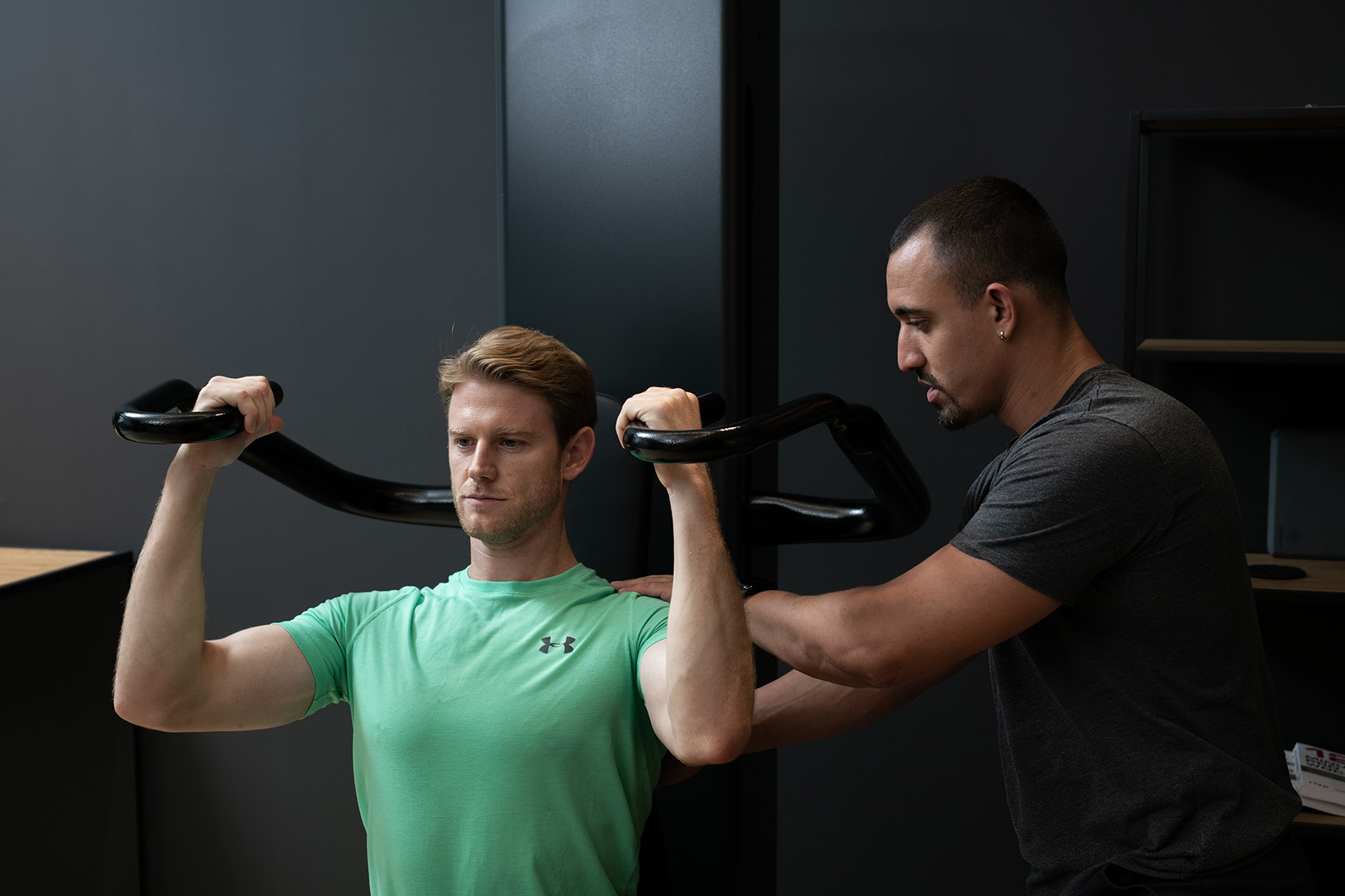
Master the
6 Exercises.
Master the Data.
The protocol is simple. Mastering it is not. Every rep cue, every curve interpretation, every metric review is an opportunity to deepen client trust and keep them returning. This is the craft of AURUM coaching.
Next: Module 4 — Principles of Training → The Science Behind AURUM