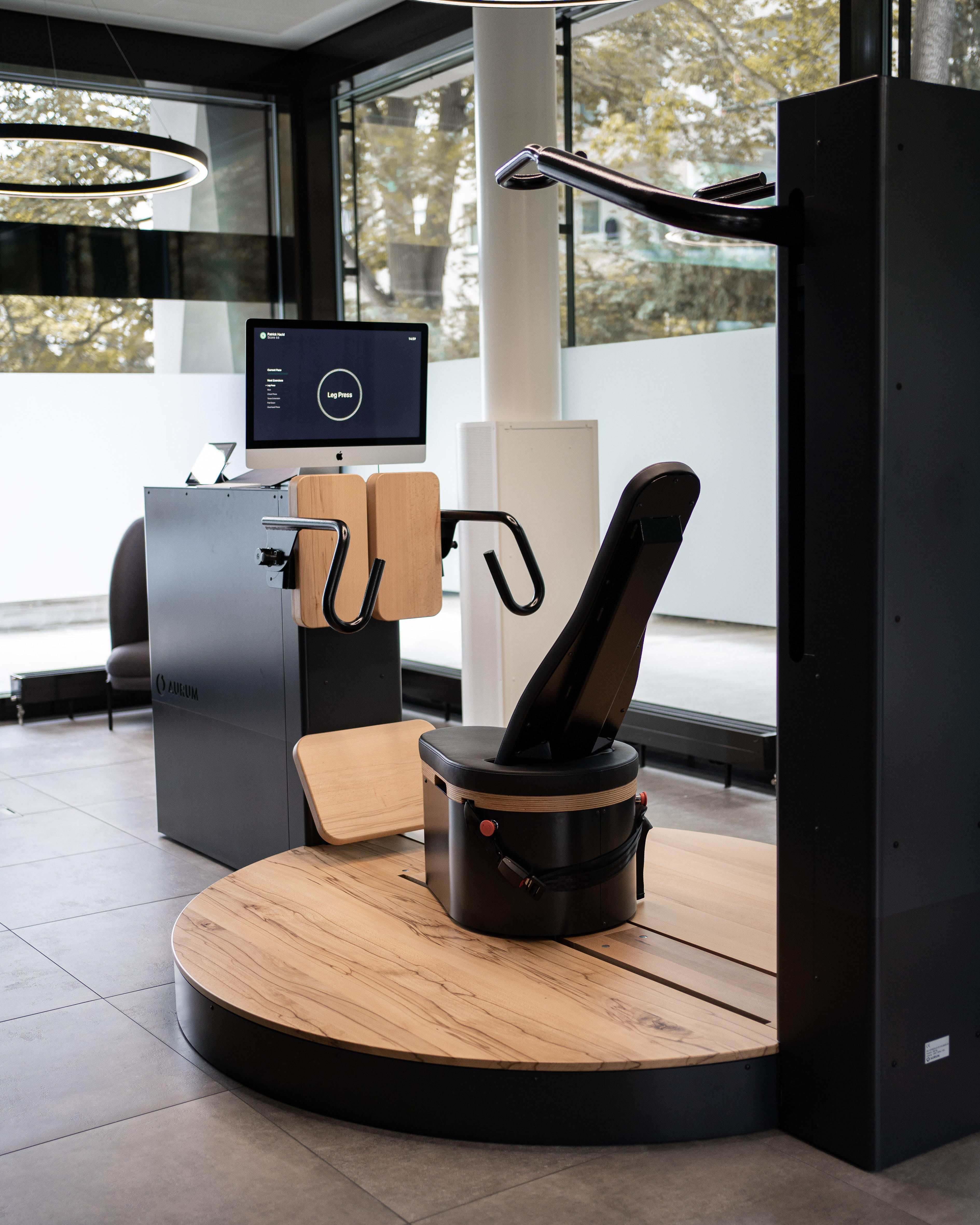
The AURUM ONE Machine
Before you can sell something, you need to understand it deeply. This module covers the technology, protocol, and data behind the AURUM ONE — so you can answer any question with confidence and demonstrate the machine like an expert.
What Is Isokinetic Training?
To sell the AURUM ONE, you first need to understand what makes it fundamentally different from any piece of fitness equipment your prospect already owns.
In conventional training — free weights, cables, machines — the resistance is fixed. You set 60 kg on the bar and lift 60 kg. The load doesn't change based on how hard you're pushing. This means at weaker points in the movement (where muscles are mechanically disadvantaged), you're under-challenged. At strong points, over-challenged. The result: uneven stimulus, wasted effort, higher injury risk.
The AURUM ONE controls the speed of the movement. The resistance it applies responds in real time to your output. Push harder — it pushes back harder. Ease off — it eases off. Every muscle fiber is maximally recruited throughout the entire range of motion.
This is why isokinetic training has been used in elite sports rehabilitation and clinical settings for decades. The AURUM ONE brings this technology into a compact, commercially viable format — for the first time, accessible outside of a hospital physiotherapy lab.
The Science Behind the Difference
Isokinetic training has been extensively studied. Key findings relevant to your sales conversations:
- Activates up to 40% more muscle fibers compared to isotonic (conventional) training (Hislop & Perrine, seminal isokinetic research)
- Produces measurably greater strength gains in shorter training windows (Dudley et al.)
- Significantly lower injury risk — the machine cannot overload the joint because resistance is velocity-dependent, not weight-dependent
- Preferred in clinical rehabilitation post-surgery (knee, hip, shoulder) because of precise, controllable loading
- Shown to be effective for sarcopenia prevention in older adults — critical for the retirement home vertical
The 16 Core Components
The AURUM ONE is precision-engineered. Understanding the hardware builds your credibility and helps you answer technical procurement questions.
- Adaptive resistance motor system — the core isokinetic engine, responds to output in real time at millisecond intervals
- Real-time force measurement sensors — captures power output, max force, and velocity data on every rep
- Ergonomic adjustable seat and backrest — accommodates users from 150cm to 200cm, <20 seconds to adjust
- 7-inch touchscreen display — guides the user through each exercise, shows live feedback
- Carbon fiber frame construction — high-strength, low-weight, minimal maintenance
- 6 attachment configurations — leg press, row, chest press, torso extension, pull down, overhead press
- Coaching App integration (iOS/Android) — operator/trainer access to client data, session history, analytics
- Training App (on-machine + mobile) — user-facing, guides session, stores performance data
- Remote diagnostics capability — AURUM can monitor machine health remotely, reducing service downtime
- Compact footprint: ~2.5 m² — smaller than a treadmill
Power Curves — The Data That Closes Deals
Every session generates power curve data. This is one of the most powerful sales tools you have — show the prospect their own curve after a demo session and the conversation changes entirely.
The machine plots force output (Y axis) against movement position (X axis) for each rep. Four curve shapes have clinical significance:
| Curve Type | Shape | What It Means | Training Implication |
|---|---|---|---|
| Parallel | Flat / even throughout | Ideal muscle activation pattern — consistent force across full range | Well-trained, optimal technique |
| Pine Tree | High at start, tapers down | Strong initial drive, drops — early fatigue or poor endurance | Focus on endurance, pacing |
| Funnel | Low start, builds up | Slow neural recruitment — warm-up compensation or inhibition | Neural activation work, pre-activation |
| Explosive | Sharp peak, drops off | Fast-twitch dominant, power without endurance | Endurance base building needed |
The Apps — Coaching & Training
The AURUM ONE ecosystem has two app layers. Understanding both helps you explain the operational fit for different partner types.
Training App (Client-Facing)
- Available on the machine's built-in screen + mobile (iOS/Android)
- Guides user through all 6 exercises in sequence — no trainer required
- Shows live feedback: current output, rep count, session progress
- Stores session history — every session is logged, progress is tracked automatically
- Personal accounts: clients log in and see their own history across sessions
Coaching App (Operator-Facing)
- Full client management: add/remove users, set protocols, view all session data
- Power curve review per client per session — identify trends, flag regressions
- Group analytics: view performance across all clients in a facility
- Used by physiotherapists to monitor rehabilitation progress objectively
- Used by hotel spa teams to give personalized post-session reports to guests
- Used by corporate wellness managers to report on employee health KPIs
InBody Integration
AURUM studios pair the training machine with InBody body composition scanning (InBody 270 or similar). Understanding this integration matters for the health and clinical verticals.
- InBody measures: Skeletal Muscle Mass (SMM), body fat %, BMI, visceral fat, segmental balance, body water
- Combined with AURUM training data: you can track if training is actually building muscle — not just improving power output
- In rehab settings: track sarcopenia reversal with objective body composition data over 3/6/12 months
- In corporate settings: InBody + AURUM = a complete wellness dashboard for employee health reporting
- In retirement homes: document fall risk reduction through improved muscle mass in lower limbs
Note: InBody integration is a partnership/add-on, not included with every machine sale. Mention it as a premium offering for facilities that want a complete measurement ecosystem.
The 6-Minute Protocol — Exactly How It Works
When a prospect asks "how does it actually work?" — this is what you tell them.
Timing Structure Per Rep
Each rep follows a precise tempo that is the foundation of the isokinetic benefit:
- 4 seconds concentric (the "push" or "lift" phase — muscle shortens, force against resistance)
- 8 seconds eccentric (the "lowering" phase — muscle lengthens, controlled return)
The eccentric phase is deliberately longer. Research consistently shows that eccentric loading is the primary driver of muscle protein synthesis and structural adaptation (Roig et al., 2009; McHugh & Cosgrave, 2010). Most conventional gym equipment neglects eccentric control — with the AURUM ONE, every rep optimizes both phases.
The 6 Exercises
- 1Leg Press — Primary: quadriceps, glutes, hamstrings. The most important exercise for sarcopenia prevention, fall risk reduction, and lower body performance. Biggest muscle groups → greatest metabolic and hormonal response.
- 2Row — Primary: rhomboids, trapezius, posterior deltoid, latissimus dorsi. Horizontal pull — comes before Chest Press to establish shoulder stability and correct posture. The back must be activated before the pushing muscles are loaded.
- 3Chest Press — Primary: pectoralis major, anterior deltoid, triceps. Horizontal push — performed after Row because shoulder stability requires back activation first. Incorrect order increases rotator cuff strain risk.
- 4Torso Extension — Primary: erector spinae, multifidus, gluteus maximus. Full posterior chain and core stabilisers. A flat power curve is correct here — this is controlled core tension, not explosive loading. The only exercise in the protocol where a Christmas-tree curve is not the goal.
- 5Pull Down — Primary: latissimus dorsi, teres major, biceps, rear deltoid. Vertical pull — targets the largest muscle of the back. First vertical movement in the sequence, introduced after the horizontal patterns are established.
- 6Overhead Press — Primary: deltoids (all three heads), upper trapezius, triceps. Smallest muscle group — placed last by design. Fatigue is most visible here and naturally serves as a demonstration endpoint with new prospects.
Why 5 Reps?
Five repetitions at full isokinetic resistance is scientifically sufficient to create maximum muscle stimulus without accumulating the volume-related fatigue that leads to injury. This is High-Intensity Training (HIT) applied through isokinetic mechanics:
- 1–2 reps: neural activation, skill
- 3–5 reps: maximum strength stimulus reached
- 6+ reps (isotonic): increasing fatigue, form breakdown, diminishing marginal returns
With isokinetic resistance, 5 reps to full effort are genuinely equivalent to 20–30 reps of conventional training in terms of muscle fiber recruitment. This is the core of the "6 minutes" claim — and it's backed by over 20 peer-reviewed studies.
Frequency & Programming
- Recommended: 1–2 sessions per week
- Recovery between sessions: minimum 48–72 hours (eccentric loading requires longer recovery)
- Progression: the machine automatically adjusts resistance as the user gets stronger — no manual plate changes
- For rehabilitation: adapted protocols available (e.g., reduced ROM, single-limb focus, velocity adjustments)
AURUM ONE vs. The Alternatives
Prospects will compare the AURUM ONE to what they already have or know. Here is the definitive comparison to have ready.
| Feature | AURUM ONE | Free Weights | Cable/Pin Machines | ARX Alpha (US) | Traditional HIT Studio |
|---|---|---|---|---|---|
| Isokinetic resistance | ✓ | ✗ | ✗ | ✓ | ✗ |
| Full-body in 6 minutes | ✓ | ✗ | ✗ | Partial | ~20 min |
| Real-time output data | ✓ | ✗ | ✗ | ✓ | ✗ |
| Power curve analysis | ✓ | ✗ | ✗ | Limited | ✗ |
| Medical certification (CE) | ✓ | N/A | Varies | US only | N/A |
| Footprint | ~2.5 m² | 20 m²+ | 4–8 m² | ~3 m² | 5–8 m² |
| Staffing required | Optional | Required | Recommended | Optional | Required |
| European distribution | ✓ | ✓ | ✓ | ✗ | Varies |
| Self-guided training app | ✓ | ✗ | ✗ | Limited | ✗ |
| Price (CHF) | On request | 5,000–30,000 | 3,000–15,000 | ~45,000 (+ import) | 15,000–40,000 |
Key Differentiators in One Sentence Each
- vs. free weights: "Free weights create risk and require supervision — the AURUM ONE eliminates both while producing provably better results."
- vs. cable machines: "Cable machines offer variable resistance but no isokinetic control, no data, and no time efficiency."
- vs. ARX Alpha: "The ARX is a US-only device with no European distribution or CE certification. AURUM is built, certified, and supported in Europe."
- vs. traditional HIT: "Manual HIT requires a dedicated trainer for every session. AURUM is app-guided — one staff member can oversee many users simultaneously."
My Notes
Use this space to jot down key points, questions, or talking points for your sales conversations. Notes are saved in your browser.